
Projects > Sensor Tilt Analysis and Adjustment
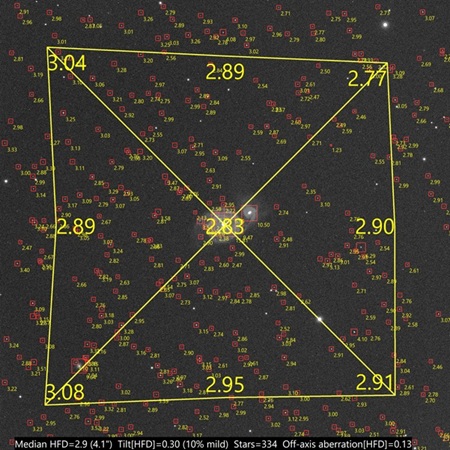
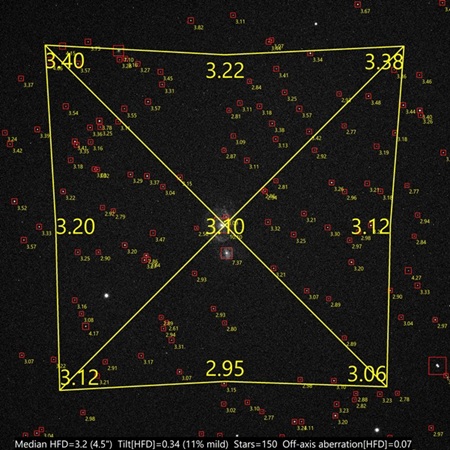
After carrying out a recent upgrade I noticed that the stars on the left side of my images, particularly the lower left corner, had skewed stars. Tracking/guiding was working well and stars elsewhere on the image looked fine. I suspected sensor tilt as the cause and analysed several of my subs using ASTAP which quantitatively confirmed what I was seeing in the images. Removing sensor tilt can be a challenging process as it's not easy adjusting push/pull set screws in the dark and the process needs to be carried out methodically to determine the effect that each adjustment makes, ensuring that refocusing is carried out after every change. To simplify the process, I purchased a set of Astrodymium rotating tilt adjusters. These are plastic spacers approximately 0.4mm thick which are slightly thicker on one side and they slip over the M42 threads of the camera and can be rotated so the thicker section is placed at any point through 360 degrees to see the effect on tilt in the image. The adjusters rely on a certain amount of play in the threads, and allow the camera to be tilted slightly relative to the adapter.
Each set of Astrodymium tilt adjusters come with 3 adjusters, each with different values for the thicker section (0.01mm, 0.02mm and 0.03mm). My plan was to start with the 0.02mm adjuster and position the thicker section so it aligned with the corner of the camera sensor. Fortunately my ASI533MC has screws on the outside of the camera that happen to align with the corners of the sensor so all I needed to do was loosen the camera, rotate the adjuster and re-tighten. That makes it sound easy, but it was complicated by the fact that each adjuster would position the camera at different orientations relative to the filter wheel and my cables were a bit tight with the camera at certain positions. It was also necessary to re-focus after each adjustment and to capture 3 separate subs for each position so an average could be taken and to rule out the possibility of a single bad sub affecting the results. I used ASTAP (Astrometic Stacking Program) to carry out the tilt analysis on each exposure.
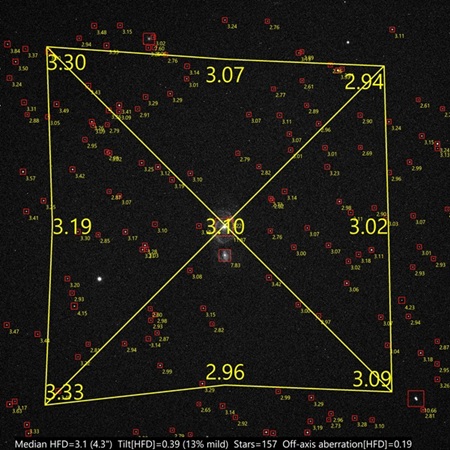
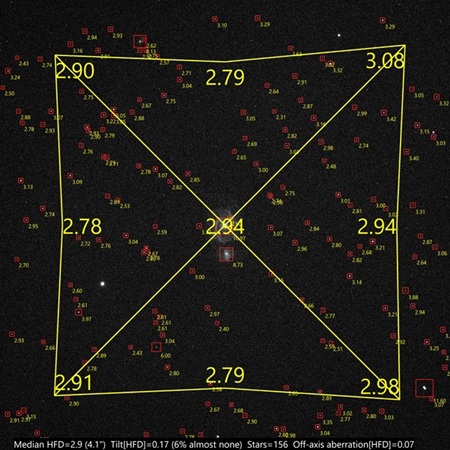
I started with the 0.02mm spacer and aligned it with the bottom left corner of the sensor. The sensor tilt in this configuration didn't look any better, but there was clearly an effect. Instead of the left side of the image showing less focused stars, now the top two corners were less focussed to a similar degree. Next I rotated the adjuster so it aligned with the top left of the sensor. The tilt appeared worse than before I started in this configuration, with the poor focus now moving back to the left corners of the image.
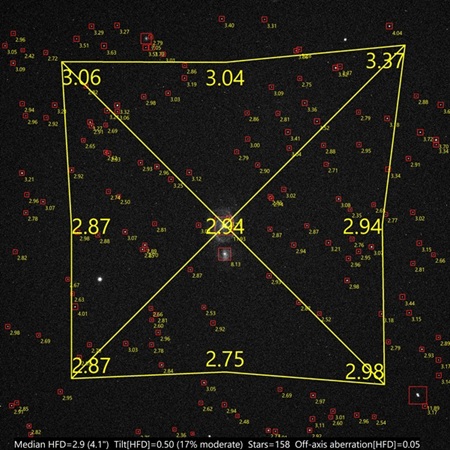
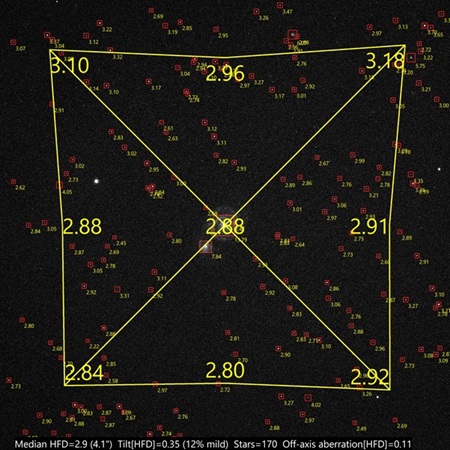
Next I moved the adjuster to align with the top right corner of the sensor. In this position the tilt was markedly reduced, with the top right corner now showing some tilt. This was promising, but for completeness I carried out a test with the 0.02mm spacer positioned at the bottom right corner. Interestingly the top right corner was far worse in this position, with the top left now also slightly out.
For consistency I was imaging the same target (M51) that I'd originally imaged when I saw the sensor tilt, and by this point there was only half an hour until a meridian flip would be required. I wanted to complete this stage of the testing with the scope on the same side of the meridian to avoid introducing other factors, such as flexure that might cause tilt to appear in different places dependent on the orientation of the scope. So, I replaced the 0.02mm adjuster with the 0.01mm version and ony tested the two positions that appeared to work best before. Firstly I tested the 0.01mm adjuster aligned with the bottom left corner of the sensor. This had a similar level of tilt compared to when I used the 0.02mm spacer.
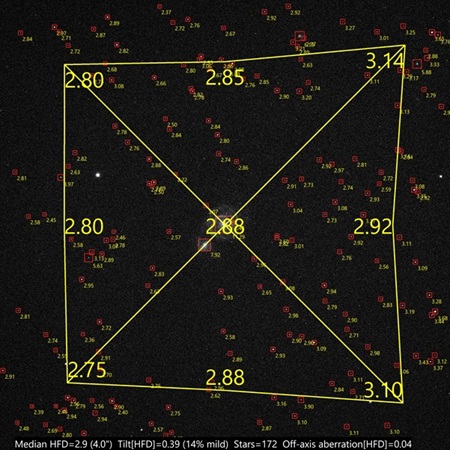
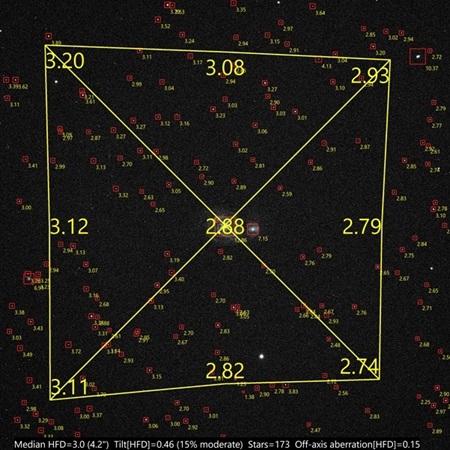
Next I tried the 0.01mm spacer in the top right corner and this showed worse tilt than with the 0.02mm spacer in the same position. By this point it seemed like the 0.01mm spacer was showing worse results than the 0.02mm, so to save time I switched to the 0.03mm as the meridian was fast approaching.
With the 0.03mm spacer installed I positioned it to align with the bottom left corner of the sensor. The level of tilt was markedly worse on the left side of the image. This was potentially good news as it meant that it was most likely the opposite corner I needed to be targeting. With this in mind, I positioned the 0.03mm adjuster to align with the top right corner.
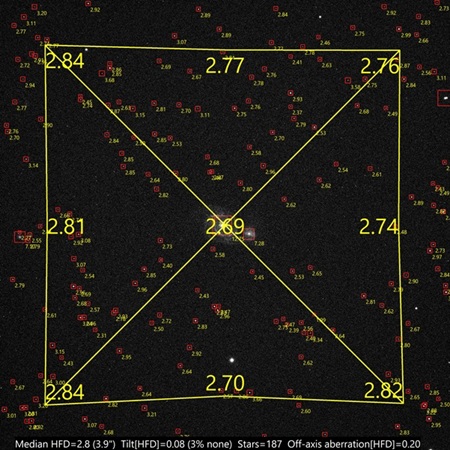
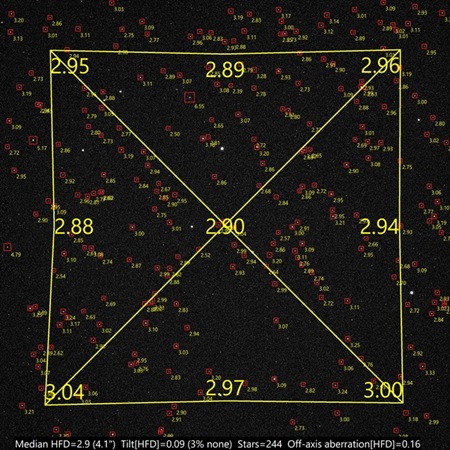
In this orientation I was pleased to see that there was very little tilt at all! With the meridian almost reached I slewed the scope to a location about 2.5 hours before the meridian to check that the results were the same. Fortunately there was very little change. Since it's possible that the sensor tilt could be caused by flexure, I carried out a meridian flip and positioned the scope towards a location approximately 3.5 hours post meridian with the scope on the eastern side of the mount. The sensor tilt analysis changed very little which was good news as it means it's unlikely to be caused by flexure and the tilt should remain corrected regardless of where the scope is pointed.
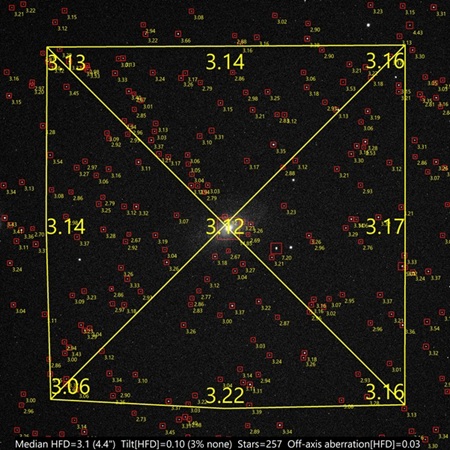
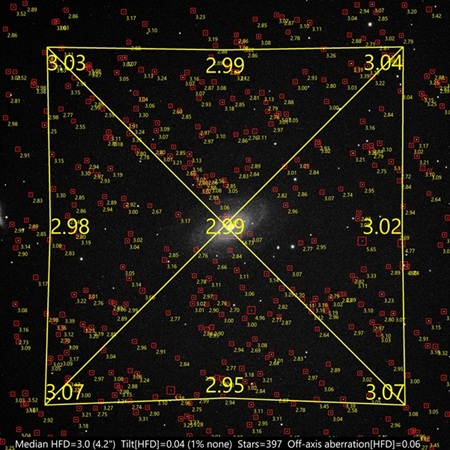
Finally, with the scope still positioned 3.5 hours post-meridian on the eastern side of the mount I carried out several 4-minute long exposures to confirm that the result was still similar. The results were better than expected with less than 1% tilt showing on the image and this was consistent across the 3 subs I collected. I'm not sure I'll leave the Astrodymium adjuster in place permanently as it may deform over time as I use the camera on different scopes. However, at least I now know where the adjustment needs to be made and by how much if I do want to use a tilt adjuster instead.